What happened
Anthropic shipped Sonnet 5 across all plans, Claude Code, and its API
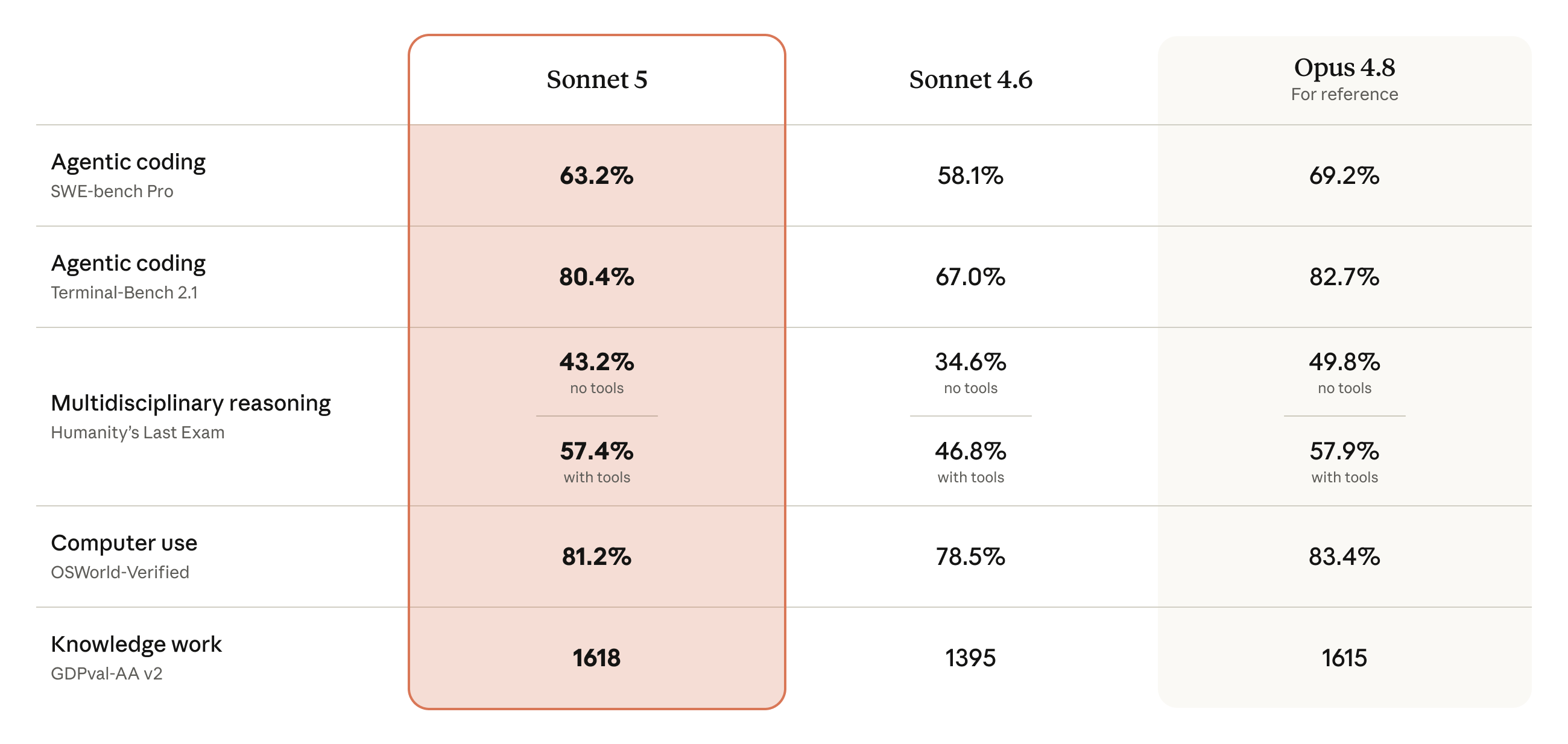
(claude-sonnet-5), positioning it as a substantial upgrade over Sonnet 4.6
in reasoning, tool use, coding, computer use, and knowledge work. The
company's framing: agentic gains had recently concentrated in its Opus-class
models, and "Sonnet 5 narrows the gap: its performance is close to that of
Opus 4.8, but at lower prices."
The cost-performance data is the interesting part. On the agentic-search benchmark BrowseComp and the computer-use benchmark OSWorld-Verified, Anthropic's published curves show Sonnet 5 strictly above Sonnet 4.6 at every effort level, with a much wider range of cost-performance options than Opus 4.8 — and higher-effort Sonnet 5 matching Opus on some tasks. Opus 4.8 runs $5/$25 per million tokens; Sonnet 5 lands at $2/$10 through August 31, then $3/$15. Anthropic also raised rate limits across Chat, Cowork, Claude Code, and the platform to absorb higher-effort token usage.
Early-access customer quotes back the agentic claim with specifics: Cursor's co-founder says agents "stay on plan" and ship multi-step changes; one Rust engineer describes Sonnet 5 unprompted writing a reproducing test, fixing the bug, then stashing the fix to confirm the bug returned; insurance and legal teams report end-to-end task completion where previous models stalled midway.
On safety, Anthropic reports lower rates of hallucination, sycophancy, and overall misaligned behavior than Sonnet 4.6, and better resistance to prompt injection — though somewhat higher misalignment rates than Opus 4.8 and Mythos Preview on its automated behavioral audit. Notably, the company says it did not deliberately train Sonnet 5 on cybersecurity: on an exploit-development evaluation built with Mozilla against Firefox vulnerabilities, Sonnet 5 never produced a working exploit (0.0%, same as Sonnet 4.6), though its partial-success rate ticked up. It ships with real-time cyber safeguards on by default — the Opus 4.7/4.8 tier of safeguards, less strict than those on Fable 5.
Why it matters
The default model tier is where agent adoption actually scales. If teams can get near-Opus behavior from the mid-tier model — and dial effort up only when a task warrants it — they can reserve frontier capacity for the moments that require it, and the economics of running agents all day change materially. Making that model the free-tier default also means Anthropic's broadest user base is now testing agentic behavior whether they planned to or not.
The caveat is tokenization: Sonnet 5 uses an updated tokenizer, and Anthropic says the same input can map to roughly 1.0–1.35× as many tokens depending on content type — the introductory pricing is explicitly set to make the transition "roughly cost-neutral." Model price comparisons still need workload measurements, not a glance at the rate card.
The fine print
Anthropic corrected its BrowseComp chart the same day: the simpler original methodology understated Sonnet 5's performance, while the update matches the system card's 10M-token budget with compaction and programmatic tool calling. It also restated Sonnet 4.6 scores for two evaluations after grader and methodology changes. All figures are Anthropic's, from the Sonnet 5 System Card.
The model menu now includes an effort dial, a tokenizer footnote, and temporary pricing. Buying intelligence increasingly resembles booking an airline seat.